Enjoy Little Things in Life

All of us get up in the morning after a good night’s sleep, but only a few of us can open our eyes and look out at the beautiful sunshine. Some can hear the birds sweetly singing, some of us can say good morning to the world with a cheerful voice and some can get out of bed healthy and strong. There are also many of whom mornings are too hectic because the children have to be off to school and they have to be off to a job. For others, the hustle and bustle are in the mind with thoughts of how to earn more money and where next to look for a lucrative job. For those in hospitals and other institutions, thoughts of returning home and rehabilitation crowd the mind… the list goes on.

However, amidst all this chaos, we must remind ourselves that no situation stays the same. The situations we find ourselves in today can change in the twinkling of an eye and the freedoms we took for granted can disappear in a second. Under such a scenario, we should keep calm and count our blessings, enjoy simple pleasures of life, and acknowledge everything that we have received. In simple words, it means learning to live your life and acknowledge everything we have received.

In simple words, it means learning to live your life as if everything were a miracle, and being aware on a continuous basis of how much you’ve have been given. Every now and then during the day just stop  for a moment and see the value of whatever you have, regardless of how little it may seem to you, because to someone less fortunate your little is quite a lot.

So, why not value what you have now? Who knows how long will you have it. So, start appreciating all the things you have in life because you never know when that time will end. Remember! happiness will never come to those who fail to appreciate what they already have.

You may read more here

Image credit

Bamboo-zled!

Indians call the bamboo ‘green gold’ because it is of such great importance. The bamboo is called the poor man’s timber’ because it is cheap and available in plenty. Bamboos are lightweight, being hollow, ramrod-straight, strong and long-lasting. Whole houses are built in the tropics with bamboo.

 City dwellers are familiar with the bamboo scaffolding that is set up to paint or repair tall skyscrapers. Tribals build large suspension bridges using only bamboo and cane. Even the great inventor, Thomas Edison, used the carbonized filament of bamboo in his early electric lamps.

The Indian paper industry demands heavily on cultivated bamboo. Tender bamboo shoots contain a poison called hydrocyanic acid when raw, but are a delicacy when cooked.

Bamboo, nature
Beautiful creations of God: Bamboo – Best friend of the environment

The bamboo is actually a type of grass, not a tree. It is called the ‘big brother’ of all grasses, because it grows to a huge size, with one species, the Giant bamboo of Myanmar, reaching a height of 37m and girth of 30cm. A few species are mere shrubs with stems no thicker than a pencil. Bamboos grow very quickly, reaching full size in about three months. Some large species add a meter a day!

There are about a 1000 species of bamboo and they are native to the warm and tropical regions. The largest number is found in Southeast Asia, which is called ‘the continent of bamboo groves’. Around 150 species are found in India. India has perhaps the world’s biggest reserves of bamboo.

The bamboo has an extraordinary flowering cycle. It flowers just once in a long while and at fixed intervals. Some species flower once in 60 years, some in 120 years. Only a few species produce flowers annually.

All the bamboos of a particular species flower at the same time wherever they are, even a thousand kilometers apart. The spectacle is breathtaking and it occurs only once in the bamboo’s lifetime.


Image credit

Beastly Slumber

Did you know?

Sleep clown, slumber, nature

  • Thrushes take hundreds of power naps a day, a few seconds at a time, in mid-flight.
  • Otters fall asleep floating on their backs, sometimes holding paws with their friends so they don’t drift apart.
Giraffe, animal slumber, trivia, nature
Giraffe
  • Giraffes snooze only 20 minutes a day, often curled up with their heads on their own rumps.
  • Brown bats doze 19 hours a day upside down.
  • The desert snail has been recorded sleeping up to four years at a time.


Crack this!

A boy wants to cross a river from south to north: he can’t swim, there aren’t any boats available, and the only bridge across the river is watched over by a guard who comes out of his hut every five minutes. It is impossible to cross the bridge in less than 10 minutes. How do you think the boy will cross the river?

*******************************************


A.  He walked across from south to north. As the guard emerged from his hut, the boy turned around and pretended he was walking from north to south. The guard then ran after him and shooed the back the way he though he had come- that is the north side of the river.


Trivia

Here is a trivia to brush up your knowledge-

Q 1.  Who administers oath of office to the President of India?


Q.2 Rudyard Kipling based his ‘Jungle Book’ on a national park in India. Name the park.


Q3. Which is India’s second permanent research station in Antartica called?


Q4. Which is the longest urban beach in India?


**************************************************


A1.  Chief Justice of India

A2.  Kanha National Park

A3.  Maitri

A4.  Marina Beach, Chennai


Maha(an) Sites

A look at the Gandhian heritage in Maharashtra

Mahatma Gandhi has ruled the minds and hearts of people since the 20th century. It is only befitting that the Government of India recently decided to refurbish 2000 places all over the world including 39 core sites that have been associated with him from 1869 to 1948.

Maharashtra has some important sites that are part of Gandhiji’s indelible legacy.

Mani Bhavan

Mani Bhavan- Mumbai, travel
Mani Bhavan-Mumbai Anurag Mallick

Whenever Gandhiji was in Mumbai between 1917 and 1934, he stayed in Mani Bhavan, a modest two-storeyed building nestled in the quiet tree-lined avenue of Laburnum Road.

Mani Bhavan witnessed the growth of Gandhiji from a humble protestor to national leader. He initiated the mass Satyagraha, Non-Cooperation, Civil Disobedience, Swadeshi and Khadi movements from here. It was here that Gandhiji took his first lessons in spinning the charkha.

Today, Mani Bhavan is a museum and research center for Gandhian studies- a perfect place to acquaint oneself with Gandhi the man and his ideology. Its library is a treasure-house of 50,000 books and periodicals. His room, which has been preserved as it was, offers a glimpse into his simple lifestyle. A miniature doll exhibition depicts the salient events in Gandhiji’s life.

Sevagram Ashram

Sevagram Ashram, Gandhiji- Travel
Sevagram Ashram

On April 30, 1936, 67-year old Gandhiji arrived at Shegaon, a small village 8 km outside Wardha town and set up an ashram on the land gifted by his industrialist friend and disciple Jamnalal Bajaj. Gandhiji insisted that the first hut called Adi Nivas be built using only the materials available locally and not cost more than Rs.500. In 1940, Gandhiji renamed the village Sevagram-village of service.

The ashram continues to observe the principles of simple living with Gandhians weaving khadi on charkhas, holding prayer meetings and growing their own food.

Sevagram boasts of the country’s first modern medical college (1969) to be located in a rural area. Its Kasturba Hospital was inaugurated by Gandhiji himself in 1944.

Adventure Mecca

Formerly called British Honduras, Belize became independent from the UK in 1981. It is the only Central American nation which uses English as its official language, though Creole is the most widely spoken.

The tropical country is blessed with an enviable marine ecosystem making it a hotspot for ecotourism. Belize offers a range of adventure activities- scuba diving, snorkelling, river rafting, kayaking, and hiking, as well as birdwatching.

Great Blue Hole, Belize, travel
By U.S. Geological Survey (USGS) – Source: [1], fetched September 2006. Caption on this USGS web page was, “Blue Hole: Aerial view of the 400-ft-deep oceanic blue hole (Lighthouse Reef Atoll Blue Hole) located east of Belize.”, Public Domain, https://commons.wikimedia.org/w/index.php?curid=1813649
The 300-km long Belize Barrier Reef is the second longest coral reef system in the world. One of its coral reefs, the Lighthouse Reef boasts of a stunning geological feature- the world’s largest underwater sinkhole, the Great Blue Hole. A perfectly formed giant circle measuring over 300m across and 125m deep, it was first popularized as a diving spot by the celebrated explorer Jacqueline Cousteau.

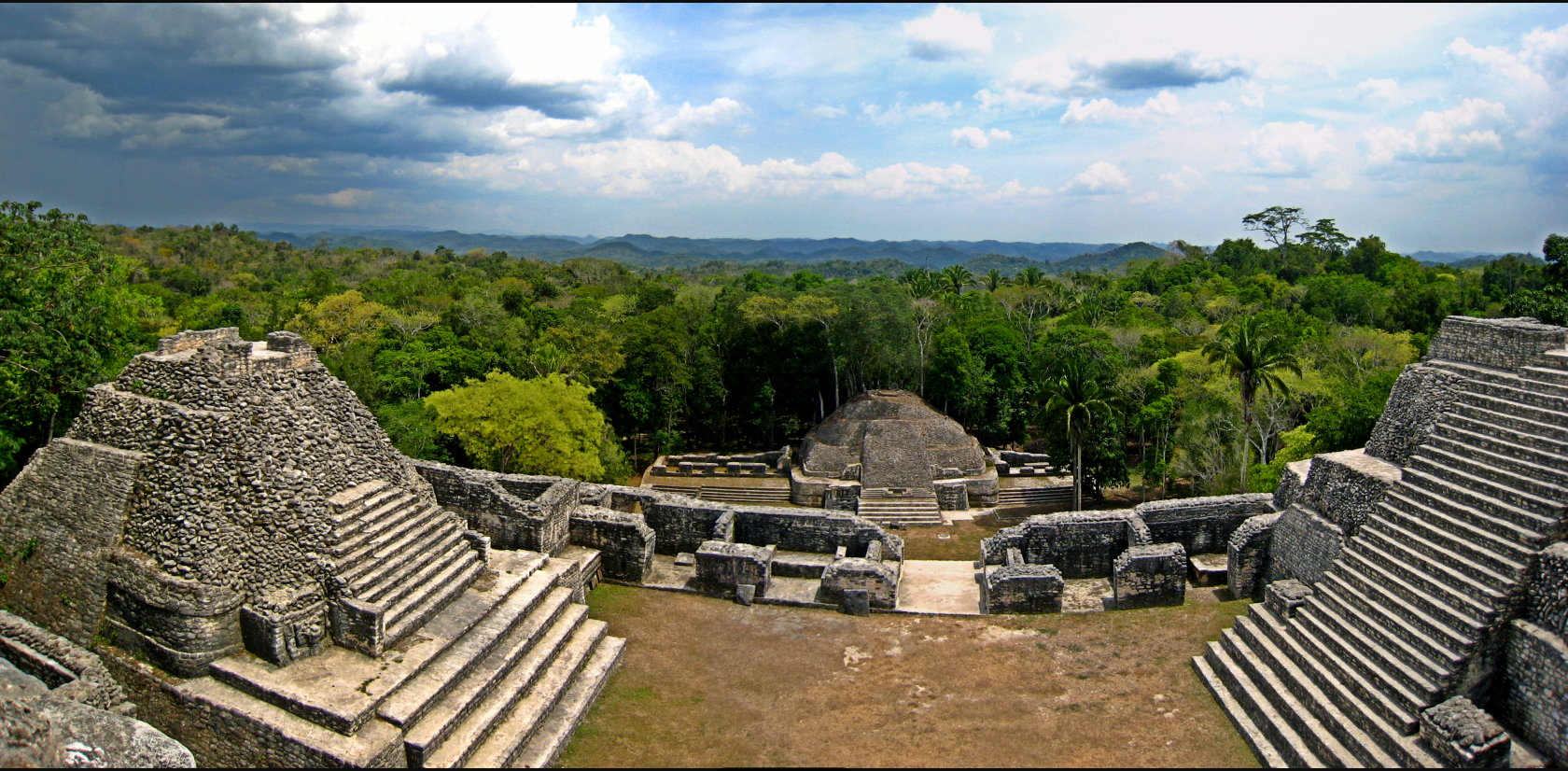
Caracol, Belize, travel
Panorama_atop_Caracol by Pgbk87

Along with natural wonders, Belize is home to several ruins belonging to the Maya civilization. Of them, Carocol was once the largest and most important political centre of the Mayan kingdom.

It is said that caves are to Belize what cheese is to the Swiss! Its vast network of underground caves is yet to be fully explored. Cave tubing, in which people float down the underground rivers on black rubber tubes, is a new fun way of discovering these caverns.