BRICS Corridors and the Hidden Power Behind BRICS+: Why It’s a Corridor Bloc
Governance Signals — Edition 5- The Corridor Century: Why BRICS+ Is Built on Routes, Not Ideology
BRICS corridors are becoming the defining architecture of the 21st century. The world is moving away from ideological blocs and toward infrastructural groupings shaped by routes, access, and geography. Edition 5 argues that BRICS+ is not a political alliance but a connectivity system — a network of corridors that bind countries through logistics rather than ideology.
This is the century where influence flows along pipelines, shipping lanes, rail networks, and digital cables. And BRICS+ sits at the centre of this infrastructural map.
1. The End of the Ideological Century
The 20th century was shaped by ideological identity — capitalism, communism, non‑alignment, and the Cold War’s binary logic.
But the 21st century has shifted:
- countries no longer align based on ideology
- domestic politics are too diverse for bloc‑based identity
- economic interdependence overrides political signalling
- geography dictates behaviour more than rhetoric
BRICS+ reflects this shift.
Its members do not share political systems or governance styles.
What they share is connectivity — the logic of BRICS corridors.
2. The Rise of the Corridor Century
The 21st century is defined by:
- energy routes
- shipping lanes
- rail corridors
- digital fibre networks
- port access
- chokepoints and bypasses
These are the new instruments of power.
They determine:
- who gets energy
- who controls logistics
- who sets prices
- who can bypass sanctions
- who can withstand disruptions
BRICS+ is built precisely on these infrastructural realities.
3. Why BRICS+ Is a Corridor Bloc
BRICS+ functions as a corridor bloc because its members are connected less by ideology and more by the physical routes that bind their economies. The grouping stretches across the world’s most strategic arteries — the INSTC, the Belt and Road spine, the Indian Ocean shipping lanes, the Gulf energy routes, and the Red Sea–Suez passage. These corridors create interdependence that no political disagreement can easily disrupt. In BRICS+, geography is the organizing principle: nations stay engaged because their trade, energy security, and logistics depend on shared routes, not shared worldviews. This is why BRICS+ continues to expand even when its members differ politically — the corridors hold the system together.
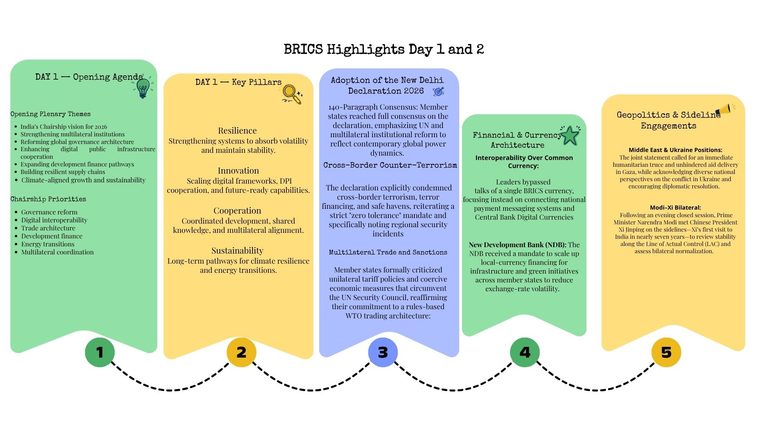
India’s expanding role in BRICS corridors is reflected in its upcoming presidency, as outlined on the official BRICS 2026 portal, which highlights India’s priorities for connectivity, logistics, and South–South cooperation.

Look at the geography:
- Russia anchors the northern land corridor into Europe and Central Asia
- China anchors the Belt and Road spine
- India anchors the Indian Ocean and the Gulf–Eurasia arc
- Iran anchors the INSTC and the Gulf chokepoint
- Saudi Arabia, UAE, and Egypt anchor the Red Sea and Suez routes
- Brazil anchors Atlantic South–South flows
This is not ideological alignment.
This is route alignment.
BRICS+ is a map before it is a manifesto.
4. BRICS Corridors Explain BRICS+ Behaviour Better Than Politics
Why did Iran join BRICS+?
Because it sits at the intersection of the Silk Route mesh, the INSTC, and the Gulf energy spine.
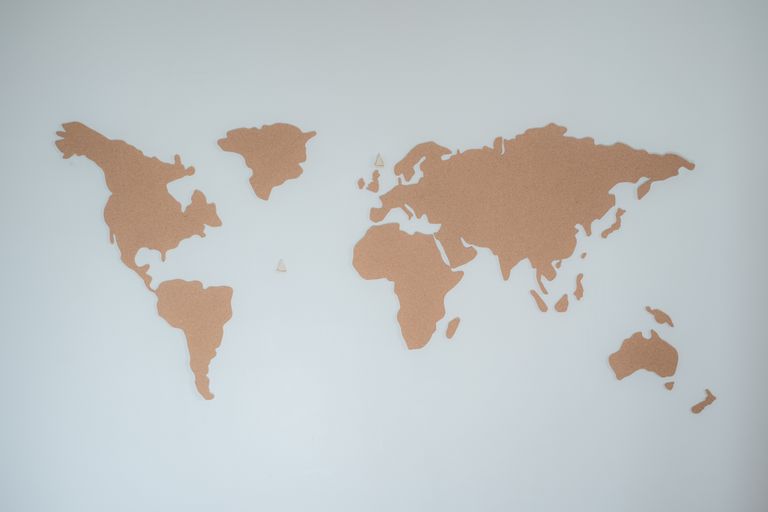
The logic of BRICS corridors becomes even clearer when viewed through the lens of the modern Silk Road. Analysts have long argued that the 21st century will be shaped by connectivity routes rather than ideological blocs, a point reinforced in this overview of the evolving Silk Road network:

Why is India central to BRICS+?
Because it is the only country that touches:
- the Indian Ocean
- the Gulf
- the Eurasian corridor
- the Indo‑Pacific
- the African maritime arc
Why are Gulf states joining?
Because they control the energy routes that feed Asia.
Why is Africa rising in BRICS+ conversations?
Because it is the future logistics frontier.
Politics explains very little.
Corridors explain everything.
5. The BRICS+ Advantage: Geography Cannot Be Sanctioned
Ideology can be sanctioned.
Geography cannot.
Pipelines, ports, and shipping lanes do not respond to political pressure.
They respond to:
- distance
- cost
- access
- chokepoints
- insurance
- risk
This is why BRICS+ has momentum even when its members disagree politically.
The corridors bind them more tightly than ideology ever could.
6. India’s Role in the BRICS Corridor Century
India’s strength in BRICS+ comes from:
- its Indian Ocean position
- its refining capacity
- its Gulf partnerships
- its Eurasian access via Iran
- its digital corridor ambitions
- its neutrality logic
India is not a follower in BRICS+.
It is a structural anchor.
In the Corridor Century, India’s geography is its greatest diplomatic asset.
7. Closing Signal
The world is entering a phase where influence flows along routes, not rhetoric.
BRICS+ is the first major grouping built on this logic.
It is not a club of like‑minded states.
It is a network of interdependent corridors — Silk Route legacies modernized into 21st‑century infrastructure.
Edition 5 marks this shift clearly:
The future belongs to those who control the routes, not the narratives.
I
Explore Governance Signals Editions