
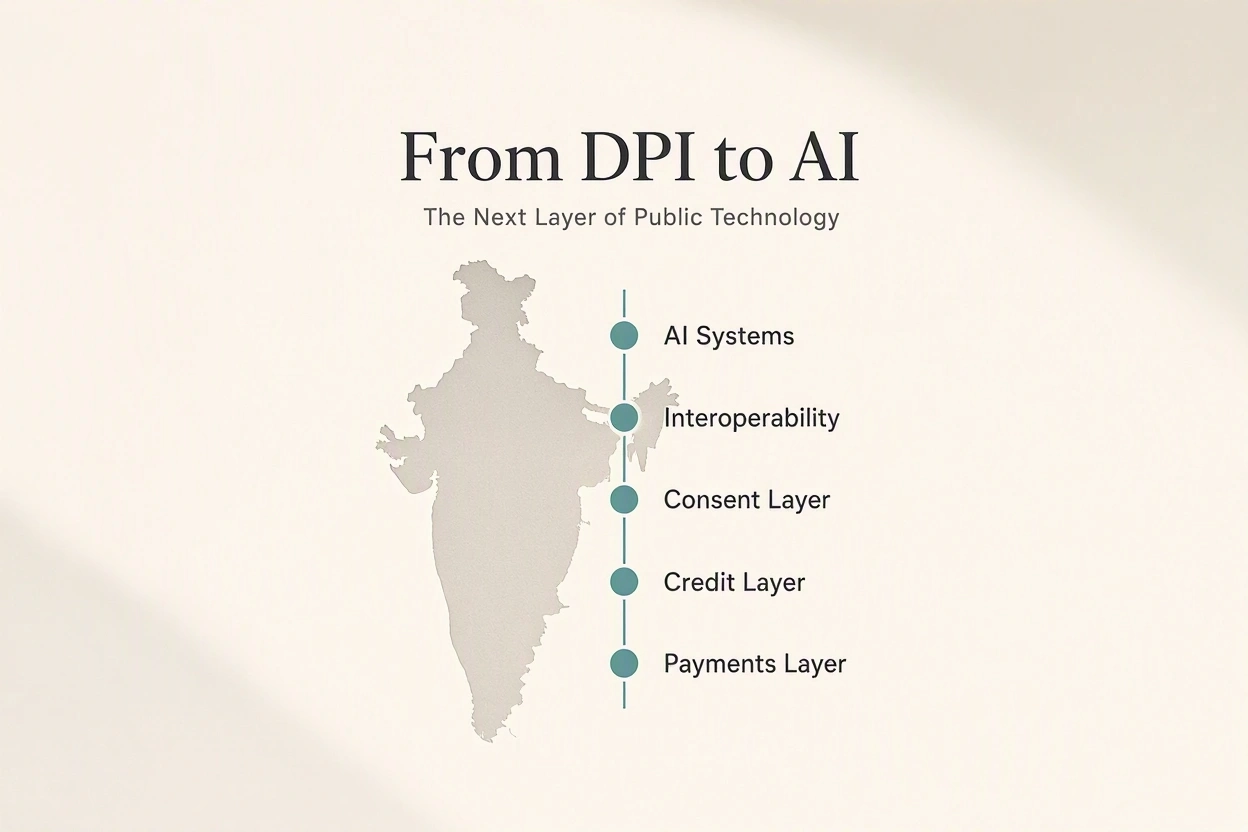
From Digital Public Infrastructure to AI Systems: The Next Layer of Public Technology
Technology Edition 1
Digital Public Infrastructure, AI & the Future of Public Technology
Technology is increasingly discussed through products, platforms, and applications. Yet some of the most consequential technological shifts of the last decade have occurred far away from the consumer spotlight.
Payments, identity, consent, compliance, and credit have gradually become shared digital infrastructure. What began as isolated technology projects are now functioning as economic and institutional systems.
India’s Digital Public Infrastructure journey demonstrated that technology can become a public utility rather than merely a commercial product.
Today, as AI moves from experimentation into deployment, a similar transition is emerging.
The question is no longer:
What can technology do?
The question is becoming:
What systems can technology support?
1. The First Layer: Digital Public Infrastructure
The foundation of India’s technology architecture was built long before the current AI wave.
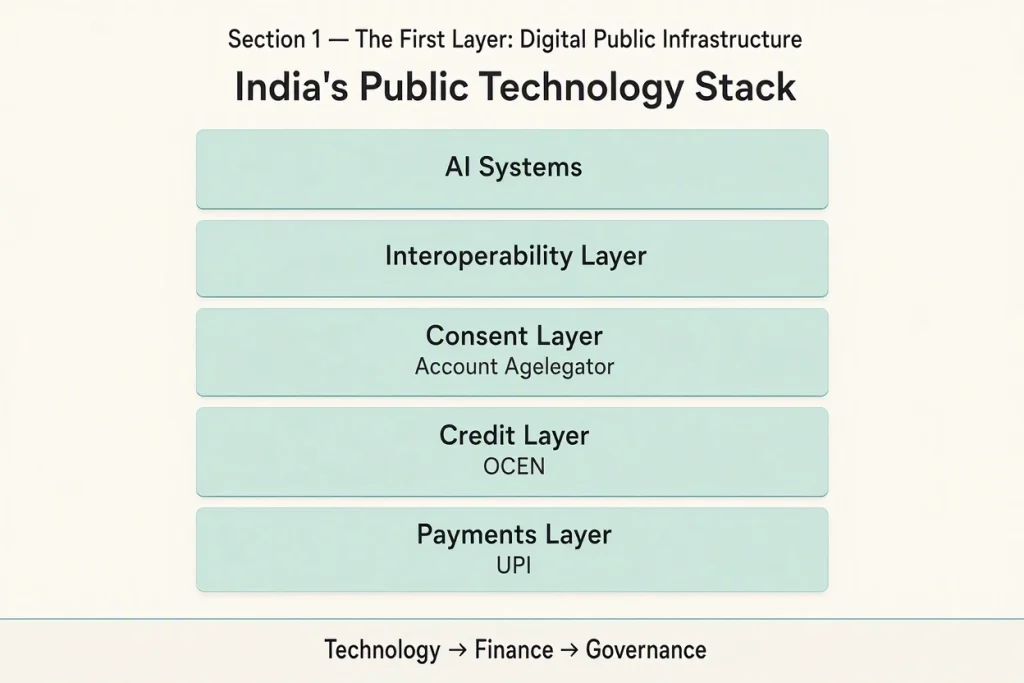
Several systems quietly created the rails now supporting payments, credit, compliance, and public services.
Core Components
Digital Payments
UPI demonstrated how interoperable payment infrastructure could operate at national scale.
Consent Architecture
Account Aggregators introduced portable, permission-based financial data sharing.
Credit Infrastructure
OCEN expanded access to digital lending by creating common credit protocols.
Together, these systems made technology infrastructure invisible, reliable, and scalable.
Technology stopped behaving like software and started behaving like public infrastructure.
Related Reading
Digital Payments
UPI: 5 Powerful Shifts That Make It the New CASA of Indian Banking
Consent Architecture
Account Aggregators: 5 Powerful Shifts Behind India’s Consent Layer
Credit Infrastructure
2. The Technology Behind Interoperability
The next stage of technological development is increasingly defined by interoperability.
Historically, technology competed through:
- features
- platforms
- proprietary systems
Today, value is increasingly created by:
- standards
- interoperability
- portability
- shared infrastructure
This shift can already be seen across:
Financial Systems
- UPI
- Pix
- Cross-border payment experimentation
Public Infrastructure
- Digital identity systems
- Compliance frameworks
- Consent architectures
Emerging International Systems
- BRICS interoperability discussions
- Digital finance pathways
- Cross-border settlement infrastructure
The systems that connect often become more influential than the systems that compete.
3. The Rise of AI as Infrastructure
The first phase of AI was consumer-facing.
The conversation focused on:
- chatbots
- image generation
- search assistants
- productivity applications
The next phase looks very different.
AI is increasingly moving into:
- enterprise workflows
- agent systems
- compliance monitoring
- financial operations
- public-sector service delivery
his transition changes the role of technology.
AI ceases to be simply a product layer.
It becomes infrastructure.
The New Question
The debate is shifting from:
What can AI do?
to
What institutional systems can AI support?
This is a fundamentally different conversation.
It is less about innovation and more about architecture.
4. When Technology Becomes Governance
Technology increasingly determines:
- access
- identity
- payments
- compliance
- information flows
At this point it becomes impossible to separate technology from governance.
The systems that enable participation also shape rules, permissions, and accountability.
Technology therefore becomes governance infrastructure.
The governance debates surrounding AI, digital identity, interoperability, and data sharing are not separate from technology.
They are an extension of technology.
Related Reading
Governance Layer
These discussions increasingly focus on standards, accountability, interoperability, and institutional design rather than products alone.
5. Technology, Finance, and Governance Converge
The traditional boundaries between sectors are fading.
Technology increasingly supports:
Finance
- digital payments
- credit systems
- capital flows
- financial inclusion
Governance
- policy systems
- compliance frameworks
- regulatory architecture
Public Infrastructure
- identity
- consent
- interoperability
- service delivery
Rather than operating independently, these systems are becoming interconnected layers of a larger architecture.
Technology no longer sits alongside finance and governance.
Technology sits at their intersection.
Closing Frame
India’s Digital Public Infrastructure journey demonstrated that technology can evolve from applications into public infrastructure.
The next question is not whether AI will transform technology.
The next question is whether AI becomes the next layer built upon digital public infrastructure itself.
The future of technology may be less about products and more about systems.
And the future of systems may increasingly depend on how technology, finance, and governance converge.