
Sohar vs Jebel Ali: How India’s New Gulf Gateway Reduces Hormuz Risk
India’s financial architecture is quietly shifting seaward.
For decades, India’s west‑coast trade has flowed through the Gulf’s dominant hub — Jebel Ali Port in Dubai. It is massive, efficient, and deeply integrated into global supply chains. But it sits behind one of the world’s most sensitive maritime chokepoints: the Strait of Hormuz.
Every spike in regional tension — Iran‑US standoffs, tanker seizures, naval patrol escalations — ripples through India’s shipping insurance, freight rates, and trade finance cycles.
This year, something changed.
India’s cargo ships began using Sohar Port in Oman as a new, risk‑free Gulf entry point. Sohar sits outside Hormuz, directly accessible from the Arabian Sea. It bypasses the chokepoint entirely.
This single geographic shift has financial consequences far beyond logistics.
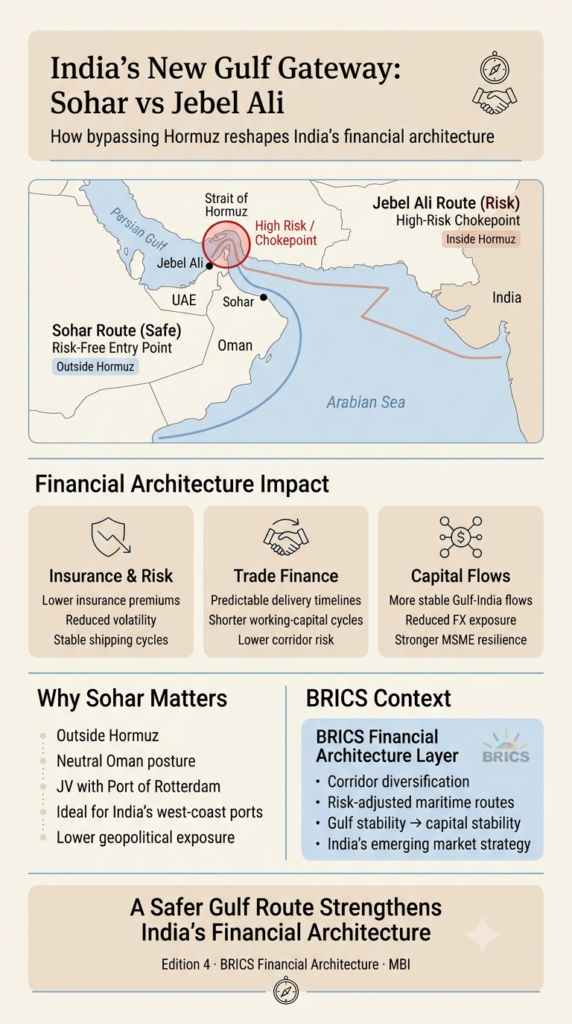
A New Maritime Layer in India’s Financial Architecture
Financial architecture is not only digital (DPI, payments, interoperability). It is also physical — the routes through which capital, goods, and risk move.
Sohar introduces a new layer:
- Lower insurance premiums during regional tensions
- More predictable shipping cycles
- Reduced volatility in trade finance
- Lower sovereign risk exposure
- Stable Gulf access for MSME exporters
When a corridor becomes safer, capital becomes cheaper.
Sohar vs Jebel Ali — The Structural Difference
Sohar Port (Oman)
- Located outside the Strait of Hormuz
- Direct Arabian Sea access
- Zero chokepoint exposure
- Joint venture with Port of Rotterdam
- Emerging industrial clusters
- Ideal for India’s west‑coast shipping routes
Jebel Ali Port (Dubai)
- Located inside Hormuz
- World’s 9th largest container port
- Massive free zone (JAFZA)
- Deep logistics ecosystem
- High connectivity across GCC, Africa, Europe
Sohar offers safety. Jebel Ali offers scale.
India is not replacing one with the other — it is diversifying risk.
Why Hormuz Matters to India’s Financial Stability
The Strait of Hormuz is a narrow, high‑risk maritime corridor. Any disruption affects:
- freight rates
- shipping insurance
- delivery timelines
- FX settlement cycles
- working capital for exporters
- commodity price volatility
For India, which relies heavily on Gulf trade, Hormuz is a structural vulnerability.
Sohar reduces that vulnerability.
Oman’s Role in Emerging Market Financial Architecture
Oman’s geopolitical posture is neutral, stable, and predictable. This matters for financial architecture because:
- neutral states reduce corridor risk
- predictable states reduce insurance volatility
- stable states reduce FX exposure
Sohar’s rise is not accidental — it is part of Oman’s long‑term strategy to become a safe logistics node for India and the wider emerging market corridor.
BRICS Context: India’s Maritime Diversification
India’s BRICS‑aligned financial strategy includes:
- reducing chokepoint dependency
- expanding alternative corridors
- strengthening west‑coast maritime routes
- integrating Gulf logistics with emerging market finance
- building risk‑adjusted trade pathways
Sohar fits into this architecture as a risk‑free Gulf gateway that stabilizes India’s capital flows.
This is financial architecture in motion — not through policy, but through geography.
What This Means for Q4 Capital Flows
As Sohar’s usage increases:
- MSME exporters face fewer shipping delays
- insurance premiums stabilize
- trade finance cycles shorten
- FX settlement becomes more predictable
- Gulf‑India supply chains become less volatile
This is the kind of structural shift that rarely makes headlines but quietly strengthens India’s financial resilience.
Closing Frame
Edition 4 expands the BRICS Financial Architecture series into the maritime domain — showing how routes, not just rails, shape financial stability.
Sohar vs Jebel Ali is not a port comparison. It is a risk architecture comparison.
And India’s decision to diversify toward Sohar marks a subtle but significant evolution in its emerging market financial strategy.
Edition 5 will move into Development Finance & Corridor Capitalization, completing the first arc of your BRICS Financial Architecture series.