BRICS 2026 — Day 3: From Ideas to Outcomes
As India concluded its BRICS 2026 Chairship at Bharat Mandapam, Prime Minister Narendra Modi’s closing remarks carried a clear message: the world today does not want just ideas — it expects concrete results. Day 3 of the Summit reflected this shift, bringing the focus firmly onto citizen‑centric cooperation, practical tools, and inclusive global governance.
For the Day 1–Day 2 governance snapshot, read the earlier post here.
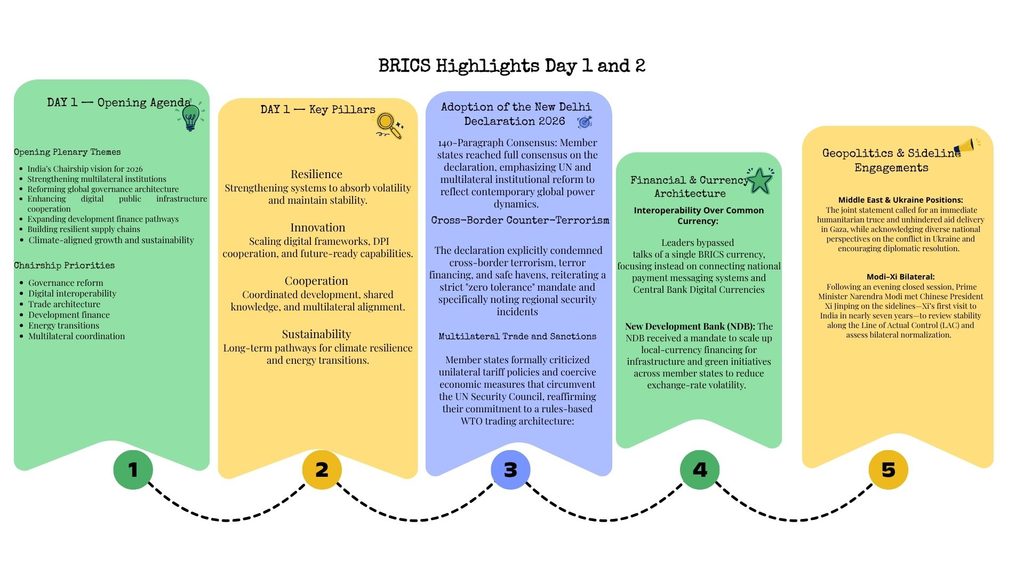
India’s Chairship closed with a governance arc built on four pillars — Resilience, Innovation, Cooperation and Sustainability — and a fifth emerging theme: Continuity, as the baton moves to China for the next cycle.
BRICS MSME Portal — A Practical Tool for Shared Growth
One of the most significant outcomes of India’s Chairship is the upcoming BRICS MSME portal. The Prime Minister highlighted it as a platform that will allow small and medium enterprises across member countries to collaborate, innovate and access new markets.
This initiative marks a shift in how multilateral cooperation is imagined. MSMEs are no longer peripheral beneficiaries — they become frontline participants in cross‑border trade, digital access and innovation exchange. It is a concrete step that translates BRICS cooperation into everyday economic impact.
Global South — A Greater Role in Rule‑Making
The Prime Minister reiterated that the Global South must play a stronger role in shaping global norms. For too long, many countries have been rule‑takers rather than rule‑makers. India’s Chairship emphasised that inclusive governance requires shared responsibility, shared voice and shared design.
BRICS becomes a platform where emerging economies can contribute to global frameworks, not merely adapt to them. This aligns with India’s long‑standing positioning on Global South leadership.
UNSC Reform — Institutions Must Reflect Today’s Realities
In his remarks, PM Modi called for urgent reform of the UN Security Council, noting that global institutions must evolve to remain credible and effective. The current structure does not fully reflect contemporary geopolitical realities, and reform is essential for legitimacy and trust.
This message connects BRICS cooperation with broader global governance reform. India’s Chairship consistently emphasised that institutions must be representative, modern and responsive.
AI Governance — Preparing for a Future Shaped by Technology
Towards the end of his address, the Prime Minister noted that AI is reshaping global systems, and the Global South must have a voice in how these technologies evolve. AI is not just a technological shift — it is a structural one.
He emphasised that emerging technologies must be governed inclusively, ensuring that their benefits reach citizens, MSMEs, farmers, students and children. This aligns with India’s leadership in digital public infrastructure and future‑ready cooperation.
Citizen‑Centric BRICS — Beyond Governments
A defining theme of India’s Chairship was the idea that BRICS cooperation must extend beyond governments. The Prime Minister highlighted that businessmen, farmers, students and children should directly benefit from BRICS initiatives.
This citizen‑centric approach transforms BRICS from a diplomatic platform into a people‑focused architecture. It ensures that multilateral cooperation translates into real outcomes for everyday lives.
China’s Participation — A Signal of Continuity
China’s active participation at the Summit, along with Wang Yi’s visit to India after seven years, signalled a commitment to institutional continuity. Xi Jinping’s engagement reflects readiness for the next Chairship cycle and reinforces the stability of the BRICS process.
This is not political commentary — it is structural rhythm. BRICS moves forward through predictable, long‑horizon cooperation.
Baton Handover — The Olympic Metaphor
As India concluded its Chairship, the leadership baton passed to China — much like the Olympic handover. It symbolises continuity, shared responsibility and the steady progression of multilateral cooperation.
India closes its term with a results‑driven message. China prepares to carry the momentum forward.
Closing
Day 3 of the BRICS Summit brought India’s Chairship to a close with a clear governance arc:
Resilience → Innovation → Cooperation → Sustainability → Continuity
The focus on MSMEs, Global South leadership, UNSC reform, AI governance and citizen‑centric cooperation reflects a shift from ideas to outcomes. As the baton moves to China, BRICS enters its next phase with stability and shared purpose.