
AI landscape 2026: The Updated 5‑Layer Model Shaping Public, Enterprise, and Global Governance
AI landscape 2026 has shifted more in the last few months than it did in the entire first half of the year. Public emotion has moved from fear to confusion, enterprises have crossed from experiments into early agent pilots, and global governance has become sharper and more assertive. This piece continues the Tech Pulse arc — think of it as a mid‑year reset built on the five‑layer model we explored in our earlier post on the AI landscape. The layers still hold, but the dynamics inside each one have changed, and those shifts will define the next six months.
A mid‑year update on how the AI landscape has shifted across public emotion, enterprise systems, and global governance.
The AI landscape 2026 Triangle (Updated)
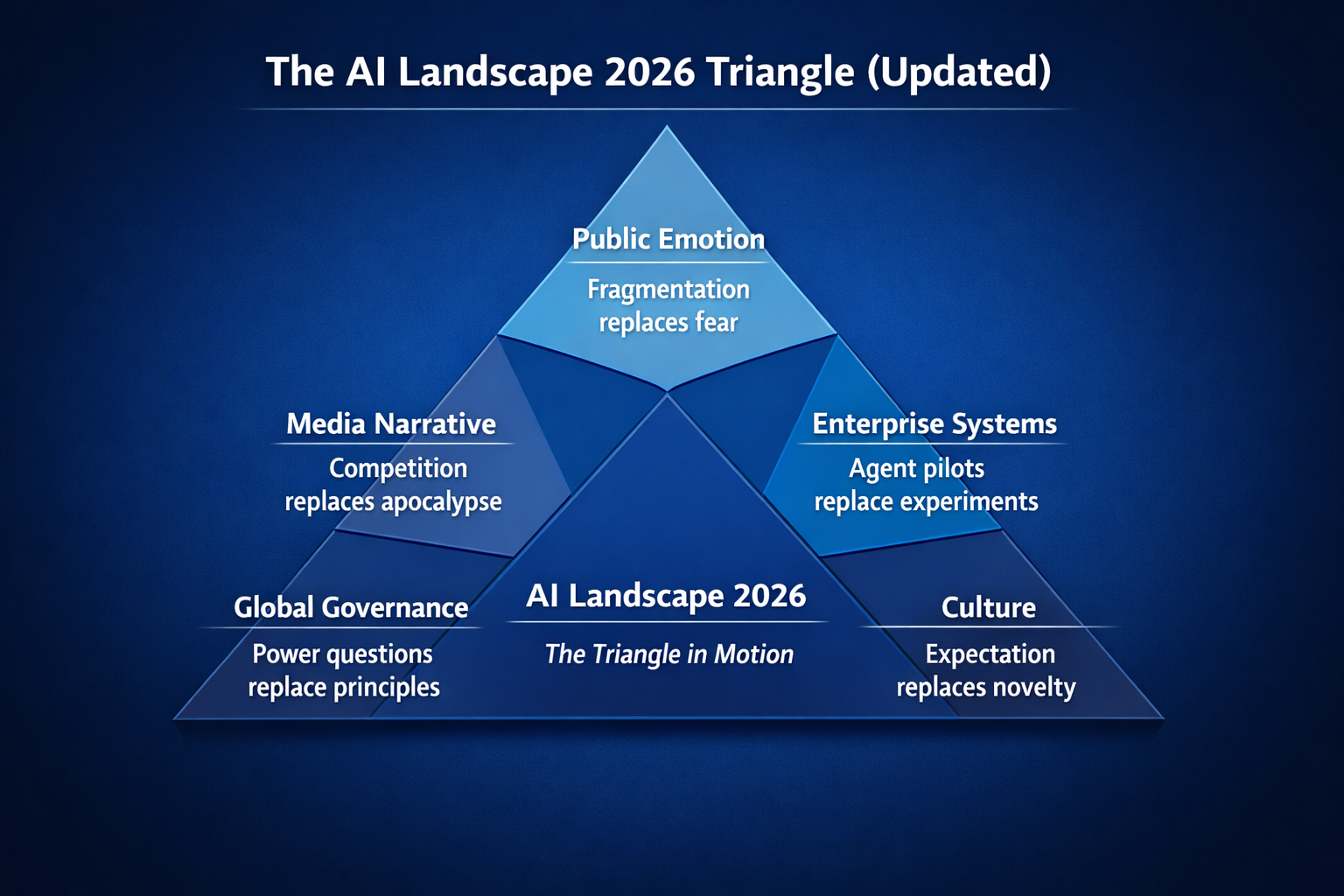
1. Public Emotion in the AI landscape 2026: From Fear to Fragmentation
Public emotion in the AI landscape 2026 has shifted from fear to fragmentation.
Public sentiment around AI has shifted in a subtle but important way. The early fear narrative — “AI will take all the jobs” — has fractured into something more complex. People are no longer reacting to AI as a single threat; they’re reacting to different kinds of AI in different ways.
- Chatbots feel familiar People now treat conversational AI like a utility — helpful, occasionally annoying, but no longer mysterious.
- Agents feel unsettling The moment AI stops waiting for instructions and starts taking actions, the emotional temperature changes. “What will it do next?” has replaced “Will it replace me?”
- Automation anxiety has become task‑specific Instead of fearing “AI will take my job,” people now fear: “AI will take the parts of my job that give me leverage.”
- Trust is uneven People trust AI for drafting, summarizing, and rewriting. They do not trust it for decisions, actions, or judgment.
This fragmentation matters because it shapes how quickly agents will be adopted — not by enterprises, but by individuals. The emotional gap between “assist me” and “act for me” is now the biggest barrier to mainstream agent adoption.
2. Media Narrative in the AI landscape 2026: From Apocalypse to Competition
The media narrative around the AI landscape 2026 has moved from apocalypse to competition.
If the public has shifted from fear to fragmentation, the media has shifted from apocalypse to rivalry. The dominant storyline is no longer “AI will end work” — it’s “AI companies are fighting for control.” This is a meaningful change in altitude.
- The doom narrative has lost momentum Headlines about mass job loss have been replaced by coverage of model releases, agent demos, and price cuts. Fear has been replaced by spectacle.
- The new media frame is competitive theatre OpenAI vs. Google. Google vs. Anthropic. Microsoft vs. everyone. The media now treats AI like a sport — with launches, leaks, and leaderboards.
- Agents have become the new storyline The shift from chatbots to agents has given journalists a fresh angle: “What happens when AI starts acting on its own?” This is less existential and more operational — a sign of narrative maturity.
- Coverage is now shaped by demos, not predictions The public no longer reacts to forecasts; they react to videos. A 30‑second demo of an agent booking a meeting generates more attention than a 30‑page report on automation risk.
- This shift matters because media narratives shape public imagination. When the story changes from “AI will replace everything” to “AI companies are racing each other,” the emotional center of gravity moves from fear to curiosity — and that changes adoption patterns.
3. Enterprise Systems and the AI landscape 2026: From Experiments to Early Agent Pilots
If the public is fragmented and the media is competitive, enterprises are quietly doing something far more consequential: they’ve begun early agent pilots. Not experiments. Not prototypes. Actual workflow‑level trials.
Scout has entered the enterprise vocabulary Microsoft’s new always‑on agent — built on the OpenClaw framework — is being positioned as the first cross‑app operator inside Microsoft 365. It doesn’t just answer prompts; it runs tasks.
The shift is from “assist me” to “handle this” Enterprises are testing agents that:
- draft documents
- update trackers
- schedule meetings
- summarize threads
- move data between apps
These are not demos. These are workflows.
The ROI conversation has changed Earlier: “Can AI help our teams?” Now: “Which tasks can agents take over without breaking compliance?”
The bottleneck is no longer technology — it’s trust and governance Enterprises want agents that are:
- auditable
- reversible
- policy‑aware
- sandboxed
- predictable
This is why Scout matters: it’s designed to operate inside enterprise boundaries, not outside them.
- The real adoption curve will be invisible Agents won’t arrive with fanfare. They’ll slip into workflows quietly — first as helpers, then as operators.
This is the altitude where AI stops being a headline and becomes infrastructure.
4. Global Governance in the AI landscape 2026: From Principles to Power Questions
Global governance has entered a new phase in the AI landscape 2026. Regulators are no longer debating principles — they’re asking power questions. The shift is subtle but decisive: the conversation has moved from “What should AI do?” to “Who gets to decide?”
- Governments are challenging frontier‑lab dominance Policymakers now want visibility into:
- compute concentration
- training data sources
- agent autonomy boundaries
- cross‑border model deployment
- The regulatory lens has widened from safety to access Earlier: “How do we make AI safe?” Now: “Who gets access to powerful models, and under what conditions?” This is a shift from ethics to economics.
- Agents have triggered new governance anxieties Regulators understand chatbots. They do not yet understand agents that can:
- take actions
- move money
- schedule tasks
- execute workflows
- interact with enterprise systems
- The geopolitical layer is becoming unavoidable AI is no longer a technology race — it’s a strategic asset. Nations are asking:
- Who controls the compute?
- Who controls the data?
- Who controls the agents that operate across borders?
- The governance gap is widening Technology is moving faster than policy, but the gap is not uniform. Some regions are accelerating oversight, while others are stepping back. This unevenness will shape how the AI landscape 2026 evolves globally.
- Global regulators are now asking power questions about compute concentration and cross‑border model deployment, as outlined by the OECD AI Policy Observatory.
5. Culture in the AI landscape 2026: From Novelty to Expectation
Culture is the quietest layer of the AI landscape 2026, but it’s also the most revealing. This is where technology stops being a headline and becomes a habit — where people no longer talk about AI, they simply use it.
- AI has moved from novelty to expectation What felt futuristic two years ago — instant summaries, rewritten drafts, auto‑generated slides — is now baseline. People expect tools to be intelligent by default.
- The cultural shift is invisible but irreversible Workers who once said “I don’t use AI” now rely on:
- autocomplete
- smart replies
- auto‑sorting inboxes
- meeting transcripts
- background task automation
They’re using AI without calling it AI.
- Agents will accelerate this shift quietly The cultural adoption curve won’t spike when agents launch. It will spike when people realize their workflows are being handled without them asking. That’s when expectation becomes dependency.
- AI is becoming a workplace norm, not a personal choice Teams now assume that documents, reports, and presentations will be AI‑assisted. The stigma has vanished. The baseline has risen.
- The cultural question is no longer “Should I use AI?” It’s “How much of my work should I let AI handle?” This is the cultural tension that will define the AI landscape 2026 — not fear, not hype, but calibration.
- Culture is the final altitude because it reveals the truth: AI adoption doesn’t happen when people understand a technology. It happens when they stop noticing it.
6. The Synthesis: The AI landscape 2026 Is No Longer One Story
The biggest shift in the AI landscape 2026 is not technological — it’s structural. Each layer of the triangle is now moving at its own speed, with its own tensions, and its own truths.
- Public emotion is fragmented
- Media narrative is competitive
- Enterprise systems are entering agent pilots
- Global governance is asking power questions
- Culture is normalizing AI as expectation
There is no single storyline that captures all of this. And that’s the point.
AI has become a multi‑layered system where progress is uneven, adoption is invisible, and impact is distributed across different altitudes. The next six months will not be defined by a single breakthrough or a single model release. They will be defined by how these layers interact — how public sentiment shapes policy, how enterprise adoption shapes culture, and how governance shapes the boundaries of agent autonomy.
The AI landscape 2026 is no longer about what AI can do. It’s about who gets to decide what it should do, how far it may go, and which parts of our work and lives we are willing to hand over to systems that operate alongside us.
This is where the next Tech Pulse arc begins — not with predictions, but with clarity.