BRICS Summit 2026 Signals: Edition 7 — Essential Indicators in the Lead‑Up to the Summit
The days leading into the BRICS Summit have opened a quiet but important stability window. There are no dramatic announcements, no sharp geopolitical shifts, and no sudden realignments. Yet the BRICS Summit 2026 signals emerging in this phase are meaningful — steady, procedural, and quietly shaping the architecture of the room.
This is the moment between corridors and conversations, where presence itself becomes a signal.
These BRICS Summit 2026 signals continue to shape the pre‑summit stability window, especially across ministerial tracks.
The Coordination Layer Before the Summit
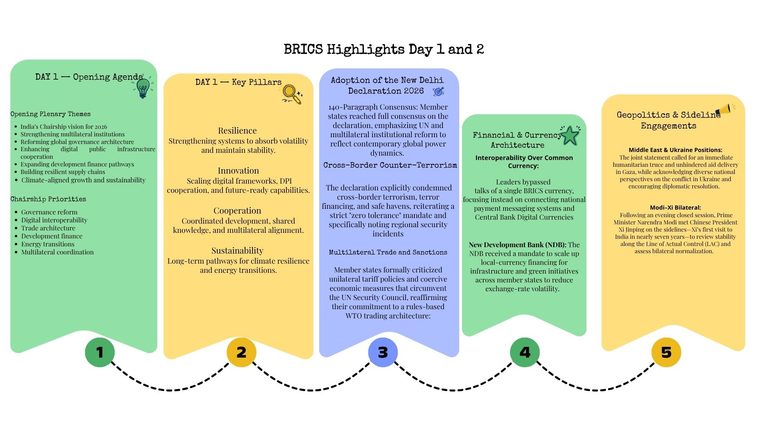
The coordination work happening now is quieter but foundational. Sherpa‑level discussions continue to refine agenda items, streamline deliverables, and ensure that the ministerial tracks remain aligned with the broader political direction. These processes rarely attract attention, yet they are essential to understanding the BRICS Summit 2026 signals emerging at this stage. The bloc’s approach remains incremental rather than dramatic, with emphasis on continuity, institutional strengthening, and predictable governance rhythms. This is the phase where frameworks are refined, language is negotiated, and the architecture of the final declaration begins to take shape.
China’s Return: The Anchor Re‑Enters the Room
China’s confirmation of participation restores the original geometry of BRICS. Earlier scheduling uncertainties had created a temporary gap, but Beijing’s return stabilises the core five. It signals continuity, intent, and engagement at a time when global volatility is high.
Signal: The architecture steadies when China is in the room.
Russia’s Momentum: Bilateral Strength Feeding Multilateral Confidence
Russia enters the Summit window with renewed bilateral momentum. The recent agreements with China — spanning energy, technology, and financial cooperation — create a corridor of confidence that naturally extends into the BRICS framework.
Local‑currency settlements between the two have expanded, not as a bloc initiative but as a bilateral system that strengthens Russia’s position within the group.
Signal: Bilateral corridors reinforce multilateral posture.
BRICS+: The Uneven Outer Layer
The expanded membership continues to show an uneven pattern of participation.
- Iran signals attendance but remains crisis‑adjacent
- UAE recalibrates amid West Asia volatility
- Egypt balances domestic pressures
- Ethiopia navigates post‑conflict stabilisation
The outer layer is present, but not uniform.
Signal: BRICS+ remains a patchwork, not a bloc.
The Currency Question: Discussion, Not Decision
The BRICS Summit 2026 signals include renewed interest in local‑currency settlements. Russia and China have strengthened their yuan–rouble corridor. Technical discussions on payment interoperability are likely.
But a unified BRICS currency remains structurally impossible.
BRICS+ includes:
- sanctioned economies
- dollar‑pegged regimes
- inflation‑volatile members
- capital‑controlled systems
Even the original BRICS cannot create a currency now without fracturing the expanded architecture.
Signal: Settlement systems are possible; shared money is not.
A recent UNCTAD note on trade and development outlines how emerging blocs are shaping regional flows.
India’s Convening Role: The Quiet Centre of the System
As host, India holds the procedural centre of the Summit. The role is not dramatic — it is architectural.
- agenda discipline
- predictable sequencing
- neutral convening
- stabilising presence
In a volatile global window, this quiet centre matters.
Signal: The host stabilises the room.
Governance Architecture: What Holds BRICS Together
Beyond attendance and announcements, the system continues through:
- ministerial tracks
- working groups
- long‑term frameworks
- payment‑system discussions
- institutional continuity
These are the slow, steady mechanisms that give BRICS its shape.
Signal: BRICS moves through systems, not statements.
Closing Signal: The Window Before Movement
The stability window is holding. Attendance signals are clearer. Corridors are active. The architecture is steady.
The next movement will come as ministerial‑level notes and agenda signals begin to surface.
Signal: The pre‑summit calm is not empty — it is preparatory.
You may explore previous edition 6 –BRICS Corridors Before the Summit: The Quiet Architecture of Power – Mix Bag of Interest
The ministerial tracks continue to shape the quieter phase before the Summit. These meetings rarely make headlines, yet they carry the operational weight of the system. Energy cooperation, digital public infrastructure, and local‑currency settlement frameworks all move through these channels long before leaders arrive. The BRICS Summit 2026 signals emerging from this layer are procedural rather than political, but they matter. They indicate continuity, alignment, and the slow, steady work of governance that defines the bloc’s long‑term architecture.