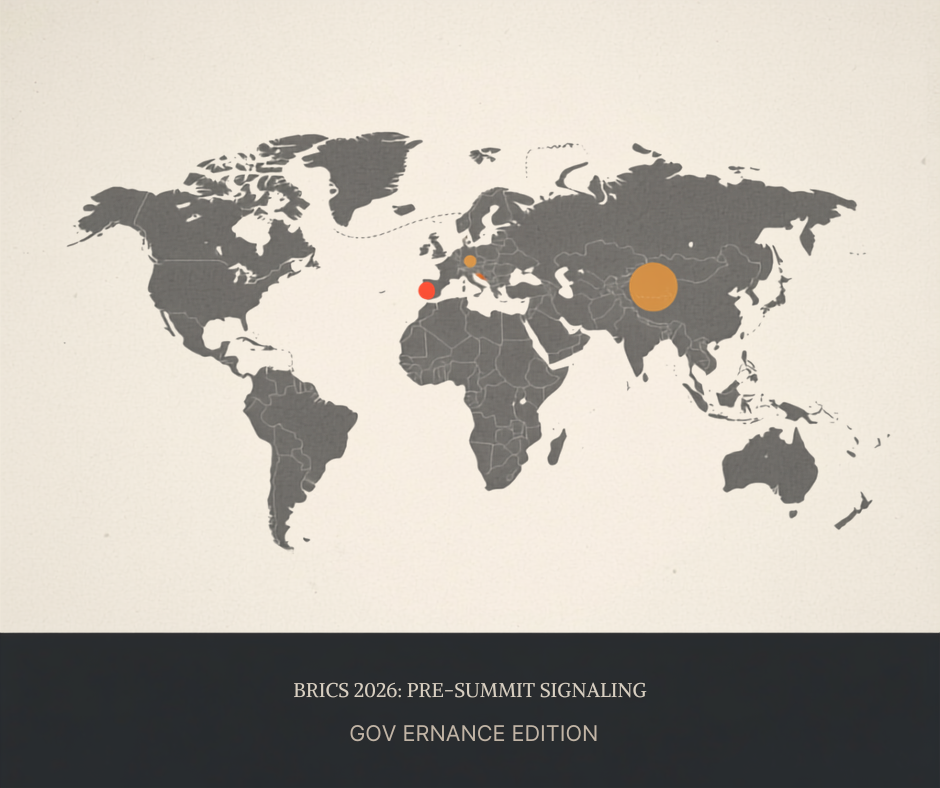
BRICS 2026: India–China Pre‑Summit Signalling and the Battle of Diplomatic Narratives
BRICS 2026 Edition — Pre‑Summit Signalling (Continuation Section)
Diplomatic Readouts as Strategic Signalling
One of the clearest indicators of India–China signalling ahead of BRICS 2026 lies in how Beijing frames its diplomatic readouts. These documents, traditionally meant to be dry summaries of shared understandings, have increasingly become strategic instruments of narrative control.
Recent examples highlight a widening “readout gap” between the two sides:
- China’s official summaries repeatedly insert claims India has not endorsed, especially on sensitive issues such as Taiwan and Tibet/Xizang.
- India’s Ministry of External Affairs has had to publicly clarify that remarks attributed to Indian officials — including S. Jaishankar and Ajit Doval —were never made.
- Beijing’s readouts often bracket Taiwan with Tibet, assert sweeping “consensus,” or imply India aligns with China’s core interests.
- None of these formulations appear in India’s official statements.
This pattern is not incidental. Analysts note that China uses readouts to:
- Project domestic strength by showing foreign leaders as affirming Beijing’s red lines.
- Create a discursive fait accompli — a narrative baseline that, if unchallenged, becomes a reference point for future negotiations.
- Signal to the Global South that India is aligned with China’s worldview, thereby shaping perceptions ahead of multilateral forums like BRICS.
India’s consistent pushback — through MEA briefings and official statements — underscores that these unilateral insertions will not go uncontested. But the larger point remains: even as both sides attempt to stabilise ties post‑Depsang/Demchok disengagement, China’s narrative engineering complicates trust‑building.
This behaviour fits squarely within the pre‑summit signalling arc discussed earlier in this post: India and China are not just negotiating positions — they are negotiating narratives.
Conclusion: Signalling Before the Summit
As BRICS 2026 approaches, India and China are shaping not just policy positions but public narratives. Beijing’s assertive diplomatic readouts, India’s calibrated clarifications, and the broader choreography of pre‑summit messaging reveal a familiar pattern: both sides are preparing the stage long before leaders arrive at the table.
For India, the priority remains clear — stabilise the relationship without conceding narrative ground. For China, the objective is equally visible — project alignment, manage optics, and influence perceptions across the Global South.
The result is a pre‑summit theatre where every statement, readout, and clarification becomes part of a larger signalling arc. BRICS 2026 will not just be a meeting of economies; it will be a meeting of competing diplomatic stories.
(Source: Firstpost opinion analysis by Sreemoy Talukdar — please confirm details with a trusted source.)