BRICS Financial Architecture: How Digital Public Infrastructure Is Reshaping Cross‑Border Capital Flows
Edition 2
The BRICS economies are entering a new phase of financial coordination — one built not on treaties or bilateral arrangements, but on Digital Public Infrastructure (DPI). What began as domestic payment innovation in India, Brazil, China, Russia, and South Africa is now evolving into a shared architecture capable of reshaping how capital moves across borders.
1. The BRICS Financial Architecture Moment
For years, BRICS financial cooperation was defined by:
- development banks,
- bilateral currency swaps,
- and political declarations.
But the real shift is happening underneath — in the rails, protocols, and governance standards that make financial systems interoperable.
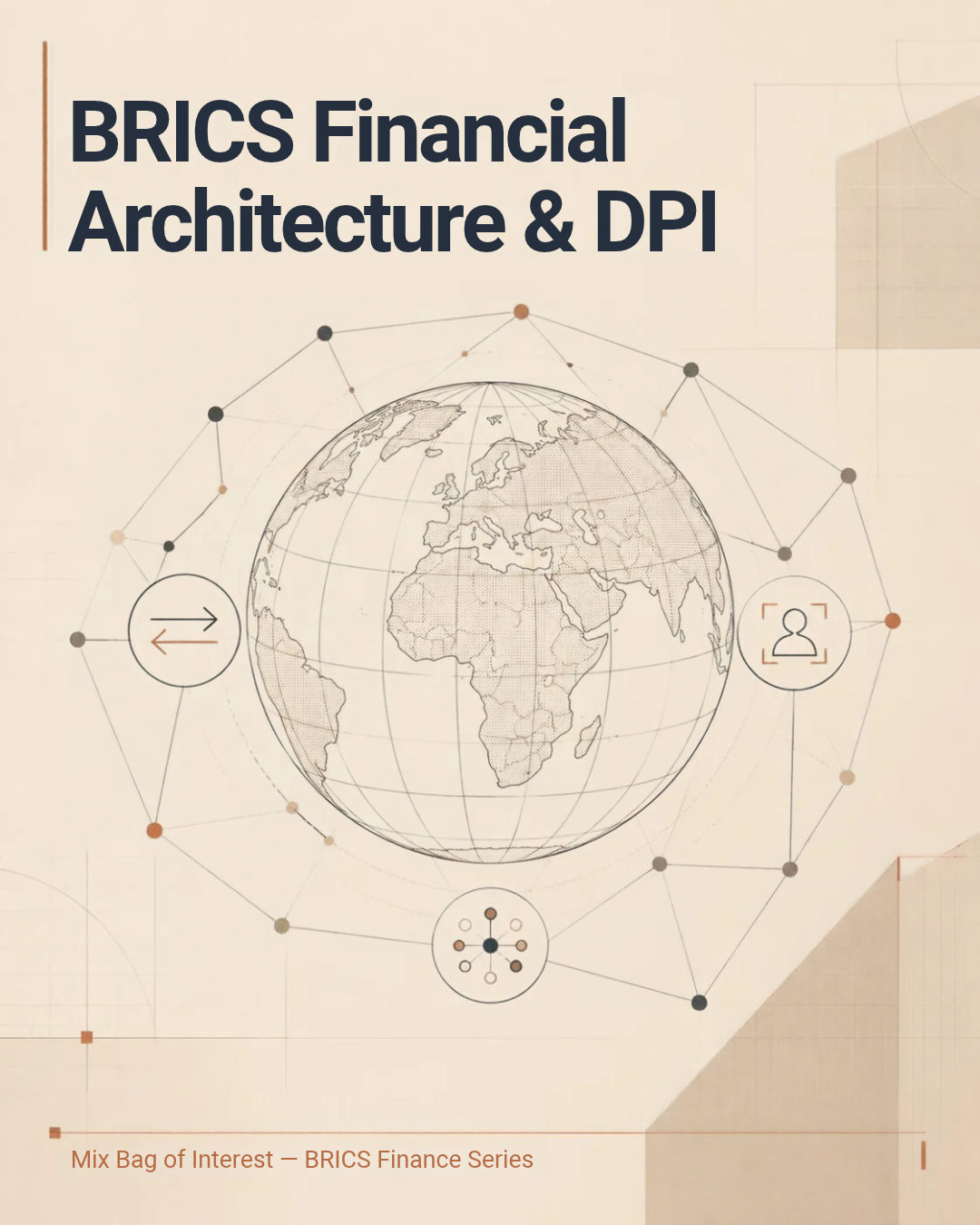
DPI is becoming the new backbone of BRICS financial architecture.
2. Digital Public Infrastructure Across BRICS
Each BRICS member has built its own domestic DPI stack. Now these stacks are beginning to align.
India: UPI + OCEN + Account Aggregator
A real‑time payments system, a credit protocol, and a consent‑based data layer — together forming one of the world’s most advanced financial infrastructures.
Brazil: Pix + Drex
Pix has become a national utility, while Drex (Brazil’s digital real) is preparing programmable finance rails.
Russia: SBP + SPFS
SBP for domestic payments; SPFS as an alternative cross‑border messaging system.
China: CIPS + e‑CNY
CIPS supports global settlement; e‑CNY introduces programmable monetary infrastructure.
South Africa: Rapid Payments Programme (RPP)
A modernized instant payments system designed for interoperability and inclusion.
Individually, these systems are powerful. Collectively, they form the foundation of a future BRICS financial network.
3. Interoperability — The Architecture Behind the Architecture
Interoperability is not just technical. It is:
- regulatory alignment,
- data governance,
- settlement standards,
- and risk frameworks.
When DPI systems begin to interlink, three things happen:
- Cross‑border payments become faster and cheaper
- Capital flows become more predictable
- Financial access expands beyond domestic borders
This is where BRICS is quietly moving — from isolated DPI systems to interoperable financial corridors.
4. MSME Cross‑Border Finance — The New Access Pathways
Post 1 established how MSMEs benefit domestically from DPI. Post 2 extends that logic across borders.
With interoperable DPI:
- MSMEs can onboard faster for cross‑border trade
- Compliance becomes digital and low‑friction
- Transaction costs drop
- Digital footprints create early credit signals
- Small exporters gain access to new markets
5. Governance Architecture — The Invisible Layer
Financial architecture is not only about technology. It is about governance.
BRICS is gradually aligning:
- data standards
- settlement protocols
- risk frameworks
- institutional coordination
- regulatory sandboxes
- digital identity norms
Governance is the architecture behind the architecture — the layer that makes DPI trustworthy, scalable, and interoperable.
6. Economic Development Implications
As DPI systems interlink, BRICS economies gain:
- Stronger regional trade corridors
- More efficient supply chain financing
- New digital trade routes
- Foundations for green financing
- Reduced friction for capital mobility
7. Closing Frame — The BRICS Finance Arc
Week 2 is the architecture week.
- Edition 1 showed how MSMEs gain credit signals through DPI.
- Edition 2 shows how DPI reshapes cross‑border capital flows.
- Edition 3 will show how this architecture supports sustainable economic pathways.
BRICS finance is no longer just about institutions. It is about systems — and the infrastructure that connects them.
Explore India’s DPI Architecture
To understand how India’s domestic DPI stack connects to BRICS‑level financial architecture, here are three foundational posts: